
Every year lakhs of aspirants prepare to crack the National Eligibility cum Entrance Test (NEET) — India’s premier medical entrance exam for admission to MBBS, BDS, and related medical courses. With the exam pattern evolving subtly over time, it’s essential to keep yourself updated so you can tailor your strategy effectively. This guide breaks down the latest NEET exam pattern, recent changes, and smart preparation tips to help you maximize your score.
NEET 2026: Exam Overview
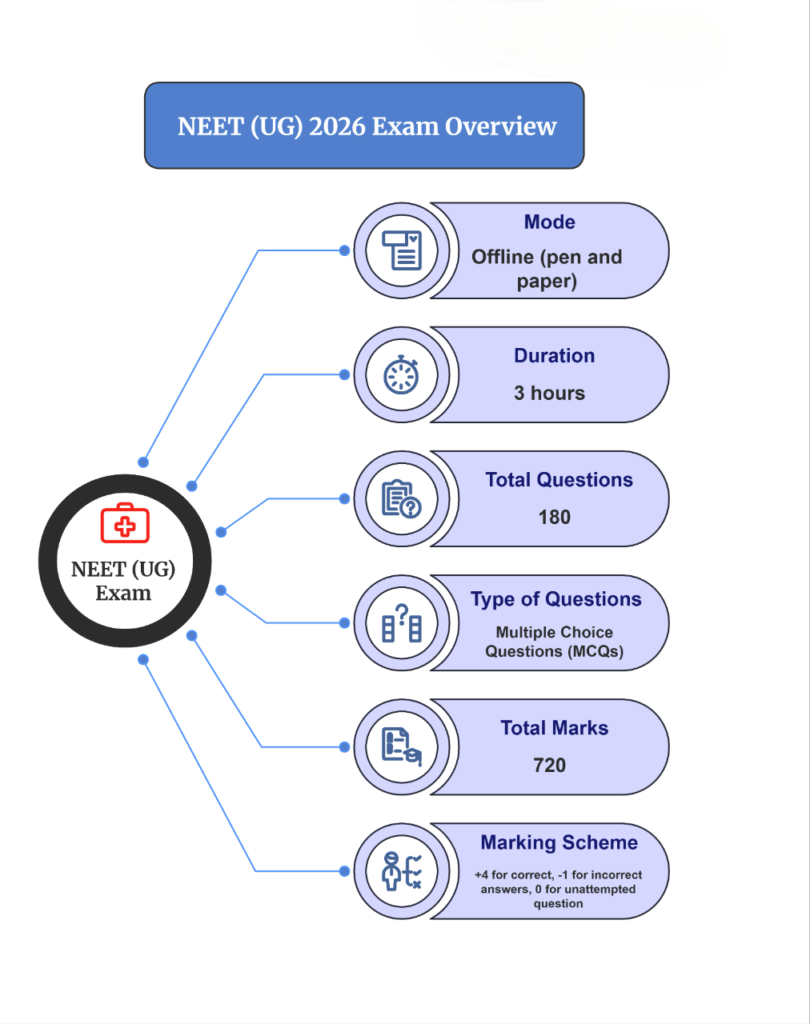
NEET is a single-stage exam conducted in pen-and-paper (offline) mode by the National Testing Agency (NTA). It tests your comprehension, reasoning, and problem-solving skills in Physics, Chemistry, and Biology.
Total Questions: 200
Questions to Attempt: 180
Total Time: 3 hours
Mode: OMR based (offline)
Marks: +4 for correct answer
Negative Marking: –1 for incorrect answer
Subjects:
- Physics – 50 questions
- Chemistry – 50 questions
- Biology – 100 questions (Botany + Zoology)
These numbers reflect the pattern followed in recent editions and are expected to continue in NEET 2026. Always confirm with the official NTA notification when it’s released.
>>Key Features of the NEET Pattern
1. Section-wise Weightage
Biology carries the most weight — accounting for 50% of the total marks. This makes it a scoring section when mastered well. Physics and Chemistry contribute equally to the remaining half.
2. Multiple Choice Questions Only
NEET consists entirely of objective-type MCQs with four options each. You must choose the most appropriate answer.
3. Negative Marking
For every incorrect response, 1 mark is deducted. As a result, blind guessing is risky — educated attempts based on elimination increase your accuracy.
4. Marking Strategy
- +4 for correct
- –1 for incorrect
- 0 for unattempted
To maximize your score:
✔ Prioritize accuracy
✔ Avoid uncertain guesses
✔ Attempt questions you are confident about first
>>Notable Recent Changes (What’s Different Now?)
To align with modern learning and reduce stress on students, the exam authority has refined the pattern over recent years:
>>NCERT Centricity
The exam remains highly based on NCERT textbooks (Class 11 & 12). Many questions are direct from NCERT diagrams or concepts, making it a core resource for preparation.
>> Balanced Sectional Mix
Each section now contains a combination of easy, moderate, and difficult questions. Biology remains comparatively accessible, while Physics often offers questions that assess deep conceptual understanding.
>> Understanding-Based Questions
There’s a rising trend toward application and reasoning-based MCQs, rather than mere fact recall. This highlights the need for thorough understanding and regular practice.
>> Smart Strategy Based on Pattern
Here’s how you can make the most of the pattern:
✔ Prioritize Biology
With 100 questions, mastering Biology can give you a strong advantage.
✔ Build Strong Concepts in Physics
Solve chapter-wise problems and use standard reference books alongside NCERT.
✔ Revise Chemistry Systematically
Aim for speed in Physical chemistry problems, clarity in Organic reactions, and firm memorization in Inorganic chemistry.
✔ Take Mock Tests
Simulate the actual exam environment — this improves time management and reduces exam-day anxiety.
✔ Analyze Previous Papers
Understanding frequently asked topics gives you a psychological edge and insight into question styles.
Final Words
Understanding the latest NEET exam pattern is crucial for shaping an effective preparation strategy. Knowing what to expect, how the scoring works, and how the pattern has evolved puts you ahead of many aspirants. Focus on concept clarity, regular practice, and smart revision — and you’ll walk into the exam with confidence.